Cookies

Your privacy, clearly explained

We use cookies to keep LinkDirect secure, improve performance, and understand how people use the product.

Back to blog

How to Open Instagram Links in an External Browser Instead of the In-App Browser

Instagram’s in-app browser can separate the first affiliate click from the browser in which the customer later completes a purchase. Learn how cookie separation affects attribution and how LinkDirect helps affiliates route supported social traffic toward external browsers.

How to Open Instagram Links in an External Browser Instead of the In-App Browser
Published:June 22, 2026Updated:June 23, 2026Reading time:14 min read

Table of contents

Expand or collapse article sections

If you want to open Instagram links in an external browser, the main concern is not simply whether the page appears in Safari or Chrome. For affiliates, performance marketers, agencies, media buyers, and brands, the browser environment can affect cookies, sessions, affiliate attribution, checkout behavior, and the customer’s ability to return to an offer later.

When an affiliate link opens inside Instagram’s in-app browser, an affiliate cookie may be stored in that embedded browser environment. If the user closes Instagram and later returns to the merchant through Safari, Chrome, or another native browser, that browser may not contain the same affiliate cookie. In affiliate programs that rely on browser-based attribution, the eventual purchase may therefore not be credited to the partner who generated the original click.

Want to test this on your own traffic?

Start with one smart link and see how many visits reach the real device browser.

LinkDirect helps you route social traffic more cleanly, preserve tracking parameters, and measure who opens in the browser versus who stays inside the app.

This does not mean every Instagram click leads to a lost commission. The outcome depends on the affiliate program, attribution model, device, operating system, merchant configuration, browser behavior, and whether additional tracking methods are used. However, the separation between Instagram’s in-app browser and the user’s regular browser creates a real attribution risk that professional marketers should understand and measure.

Instagram commonly opens external links inside an embedded browser. This allows users to visit a website without completely leaving the Instagram application. The same behavior can apply to links in profile bios, Stories, advertisements, direct messages, creator profiles, and other supported placements.

For the user, the transition is fast. The visitor can view the page, close it, and immediately return to Instagram. For an affiliate or performance marketer, however, the click may take place in a browser environment that is separate from Safari, Chrome, or another native browser the customer normally uses.

An in-app browser may have its own cookies, session data, login state, privacy settings, and app-opening behavior. The exact implementation varies between platforms, devices, operating systems, and application versions.

The problem is not that Instagram always removes affiliate tracking. The more important issue is that the first affiliate click and the eventual purchase may happen in two browser environments that do not share the same cookies or sessions.

How Instagram’s In-App Browser Affects Affiliate Cookies

Many affiliate programs use browser cookies as part of their attribution process. When a visitor clicks an affiliate link, the merchant or affiliate network may place a cookie in the browser. This cookie can identify or reference the affiliate responsible for sending the visitor.

If the visitor completes a qualifying transaction during the attribution period, the platform may use that cookie to connect the sale with the original affiliate click. The precise process depends on the program, but browser continuity can be an important part of successful attribution.

Consider a user who taps an affiliate link in an Instagram Story. The merchant’s website opens inside Instagram’s in-app browser, and the affiliate cookie is stored within that browser context.

The visitor reads the offer, checks the price, and closes the page without completing the purchase. A few hours or days later, the same person opens Safari or Chrome, searches for the merchant, and purchases the product directly.

The native browser may not have access to the affiliate cookie previously stored inside Instagram. If the affiliate program relies on that cookie to recognize the referral, the final transaction may not be connected to the original affiliate click.

The affiliate generated the interest and introduced the customer to the product, but the sale may appear in analytics as direct traffic, organic traffic, another marketing channel, or an unattributed conversion.

Why Delayed Conversions Are Particularly Important

Many customers do not convert during their first visit. They compare prices, read reviews, check delivery conditions, wait for a better moment, or discuss the purchase with another person.

This is especially common in industries such as travel, finance, insurance, software, electronics, premium ecommerce, online education, and other categories with longer decision cycles.

If the first affiliate visit happens inside Instagram but the later purchase happens inside Safari or Chrome, browser-based attribution may be interrupted. The longer the conversion path, the more important browser continuity can become.

It is important not to present cookie separation as an automatic loss of every commission. Some affiliate programs use server-side tracking, account-level attribution, postback systems, conversion APIs, discount code attribution, or other methods that can supplement browser cookies.

A merchant may also have its own mechanisms for reconnecting users with earlier campaign interactions. As a result, an in-app browser does not guarantee that attribution will fail.

However, affiliates often work with multiple merchants, networks, and tracking implementations. They cannot assume that every partner can reconnect a later native-browser purchase with an earlier in-app browser click. Reducing browser separation is therefore a practical way to protect the value of social traffic.

How the Instagram In-App Browser Can Affect Conversion Flow

Affiliate cookies are a major concern, but the Instagram browser can also affect other parts of the customer journey. These include account sessions, saved carts, checkout behavior, mobile app opening, and campaign analytics.

Existing Customer Logins

A customer may already be signed in to a merchant account in Safari or Chrome. That login session may not be available inside Instagram’s browser.

The user may need to enter a password again, confirm an email address, complete two-factor authentication, or recover an account. Each additional step introduces friction and creates another opportunity for the visitor to abandon the process.

Saved Carts and Previous Sessions

Customers often return to previously viewed products, saved baskets, wish lists, booking searches, or account dashboards. These sessions may exist in the native browser but not in Instagram’s embedded browser.

A visitor arriving through Instagram may therefore see a different account state from the one available in Safari or Chrome. This can be especially relevant for travel platforms, marketplaces, subscription services, and stores with longer purchase processes.

Checkout and Payment Behavior

Some payment systems, banking applications, mobile wallets, and verification steps may behave differently inside an embedded browser. The user may encounter problems when returning from another application, completing payment confirmation, or opening a preferred payment method.

The Instagram browser does not automatically break checkout. However, it adds another variable to a process in which every unnecessary action can reduce conversion performance.

Mobile App Opening

Some affiliate links are intended to open a merchant’s installed mobile application. Whether this happens depends on the merchant’s app-link configuration, the operating system, Instagram’s behavior, the device, and the user’s settings.

An external browser may provide a more familiar transition into the merchant’s application or allow the visitor to continue on the website when direct app opening is unavailable.

Analytics and Campaign Measurement

Affiliate identifiers and UTM parameters are not automatically removed simply because a link opens inside Instagram. The original click can still be recorded correctly.

The measurement problem may appear later when the customer moves between Instagram, a native browser, a merchant application, and a direct return visit. A campaign may record the click without successfully connecting that interaction with the eventual conversion.

This is why affiliates should evaluate more than click volume. Browser opens, approved commissions, delayed conversions, revenue per click, checkout completion, and users who remain inside the application provide a more complete picture.

Why Manual External Browser Instructions Are Not Scalable

An individual Instagram user can sometimes open the in-app browser menu and choose an option such as “Open in Safari,” “Open in Chrome,” or “Open in external browser.” The user may also copy the URL and paste it into another browser.

This can solve the issue for one person, but it is not a scalable strategy for affiliate marketing or paid social campaigns.

Most visitors do not understand the difference between an embedded browser and a native browser. They are unlikely to search through menus, copy links, or follow technical instructions before viewing an offer.

Every additional step can reduce click-through rates and increase abandonment. Professional marketers should not build their conversion strategy around the assumption that every user will manually move a page into Safari or Chrome.

A more scalable solution is to use browser-aware smart routing that attempts to move supported visitors toward the device’s external browser earlier in the customer journey.

Want to test this on your own traffic?

Start with one smart link and see how many visits reach the real device browser.

LinkDirect helps you route social traffic more cleanly, preserve tracking parameters, and measure who opens in the browser versus who stays inside the app.

Affiliates, agencies, brands, and performance marketers need a solution that works at the campaign level. The routing process should not depend on each user finding a hidden browser setting.

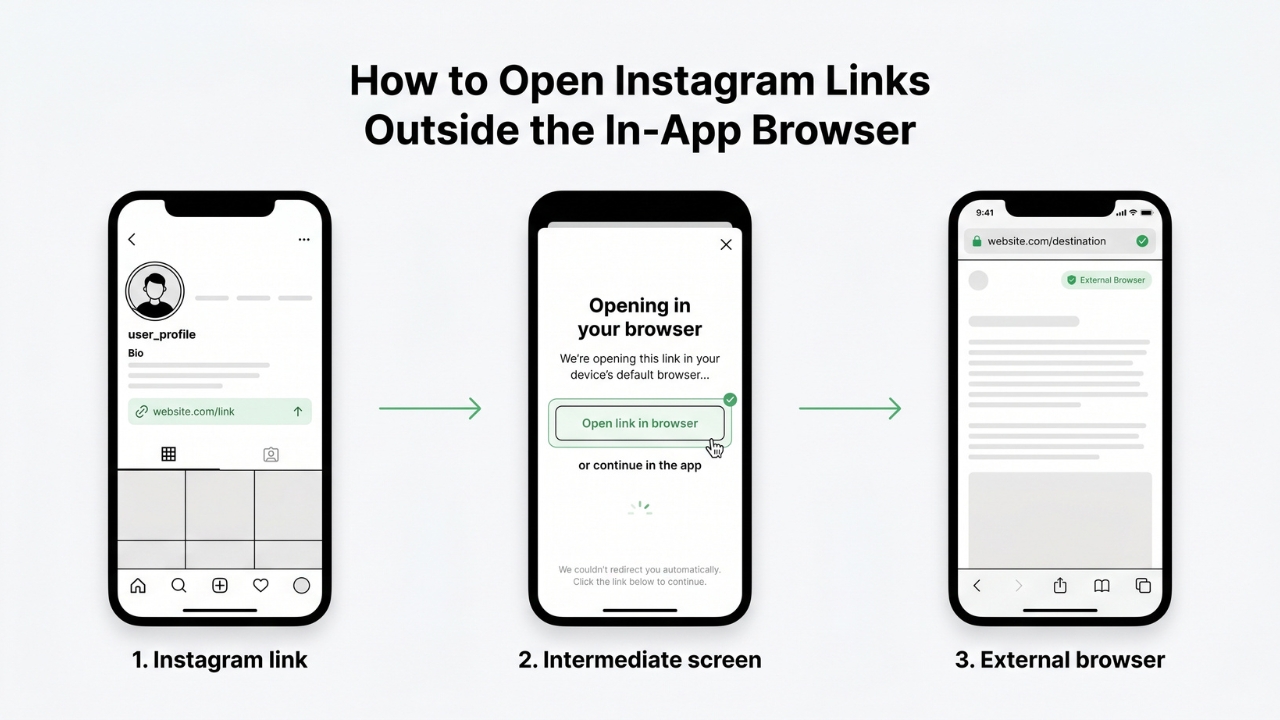
A browser-aware smart link can identify that a click is coming from an embedded social browser and guide the visitor toward the best available destination. When supported, the flow can attempt to continue in the external browser. When direct opening is unavailable, the user should receive a clear fallback that allows the journey to continue.

The original destination must remain intact, including affiliate IDs, UTM parameters, campaign identifiers, and other tracking values. The transition should also remain simple and understandable so it does not introduce unnecessary friction.

How LinkDirect Helps Instagram Affiliate Traffic

LinkDirect is a paid subscription SaaS for affiliates, performance marketers, agencies, brands, media buyers, funnel owners, and creators who monetize social traffic. It is not a consumer product intended for ordinary Instagram users who occasionally want to open a page in Safari.

LinkDirect helps professional marketers route supported traffic from Instagram, Facebook, Messenger, and other social applications toward the device’s external browser earlier in the conversion journey.

The platform uses browser-aware smart routing, environment detection, a native-open flow, attribution-safe redirects, and a conversion-friendly fallback. LinkDirect does not guarantee that every click will open outside Instagram because the final behavior depends on platform restrictions, application versions, operating systems, devices, user settings, and destination configuration.

A LinkDirect subscriber can create a smart link that points to an existing affiliate offer, landing page, ecommerce product, booking website, lead form, sales funnel, or checkout page.

When a visitor clicks the LinkDirect URL inside Instagram, the platform identifies the browsing environment and attempts to guide the user toward the best supported opening method.

If external browser opening is supported, LinkDirect helps continue the journey in the user’s native browser. If direct opening is unavailable, the platform provides a clear fallback so the visitor can still access the destination.

The original destination and tracking parameters can be preserved, including affiliate IDs, UTM values, campaign tags, and other identifiers required for attribution and analytics.

The main value for affiliates is that the first merchant visit has a better chance of taking place inside the browser the customer normally uses.

If the original affiliate cookie is stored in Safari or Chrome instead of only inside Instagram’s in-app browser, the cookie may still be available when the customer later returns through the same native browser.

This can improve the chance of maintaining attribution in affiliate programs that rely on browser cookies. It does not guarantee that every sale will be credited, but it can reduce one of the common causes of cookie and session separation.

Custom Subdomains for Branded Campaigns

LinkDirect subscribers can create smart links using their own subdomains. This allows agencies, affiliates, and brands to maintain consistent link branding across Instagram Stories, profile links, direct messages, creator campaigns, and paid advertisements.

A branded subdomain can make the transition feel more trustworthy and more closely connected to the original campaign than an unfamiliar generic redirect URL.

LinkDirect Site Scripts

Marketers who control their own websites can use LinkDirect site scripts. A lightweight script is placed in the head section of the website and helps identify visits arriving through supported in-app browsers.

The visitor can then be guided through the LinkDirect transition flow even when the original click did not use a LinkDirect smart link.

Site scripts are particularly useful for agencies, brands, and funnel owners that send traffic from many Instagram campaigns to the same website. Smart links optimize individual campaign URLs, while site scripts can help manage a broader share of social traffic reaching an owned domain.
How LinkDirect Analytics Helps Measure In-App Browser Traffic

LinkDirect allows subscribers to analyze how visitors move through the browser-opening flow instead of relying entirely on assumptions.

The platform provides metrics such as total clicks, browser opens, users who stayed in the application, traffic sources, devices, operating systems, countries, and live click flow.

This information can be compared with affiliate network reports, merchant analytics, approved commissions, CRM data, conversion rates, and revenue per click.

The objective is not to classify every in-app browser visit as a lost sale. The goal is to understand how much valuable traffic remains inside an embedded browser and whether external-browser routing improves the conversion journey.

Create separate LinkDirect smart links for different Instagram placements. A profile link, Story campaign, direct-message promotion, creator collaboration, and paid advertisement may produce different user behavior and should be measured independently.

Preserve affiliate identifiers, UTM values, campaign names, and placement parameters. External-browser routing should support your existing tracking structure rather than replace it.

Test the entire customer journey on both iOS and Android. Check whether the destination opens correctly, whether affiliate parameters remain present, whether cookies are created, whether login sessions work, and whether checkout can be completed.

Analyze delayed conversions as well as purchases completed during the first session. This is especially important for products with longer decision cycles.

Use a branded custom subdomain to improve consistency and trust. The smart link should feel like a natural part of the campaign instead of an unrelated redirect.

Compare performance before and after implementing LinkDirect. Review browser opens, users who stayed in the application, conversion rate, revenue per click, approved commissions, completed checkouts, and lead quality.

Why External Browser Routing Matters for Affiliates

Opening Instagram links in an external browser is not primarily a convenience feature. For professional affiliates and performance marketers, it is an attribution, conversion, and revenue protection strategy.

If an affiliate cookie is stored only inside Instagram’s embedded browser and the customer later purchases through Safari or Chrome, the original partner may not receive credit in a cookie-based attribution model.

LinkDirect helps reduce this risk by attempting to move supported social traffic into the user’s native browser earlier in the conversion journey. Smart links, site scripts, custom subdomains, browser-open analytics, and conversion-friendly fallbacks give affiliates greater control over how social clicks reach the final offer.

Create a LinkDirect smart link and help your Instagram traffic open where it should.

Topics

Author

LinkDirect Editorial Team

Editorial team

5 articles

The LinkDirect editorial team writes about smart redirects, in-app browsers, attribution recovery, and mobile-first conversion flows.

FAQ

Frequently asked questions

Why do Instagram affiliate links open in an in-app browser?

Instagram commonly opens external links inside an embedded browser so users can view websites without leaving the application. For affiliates, this can create a separate cookie and session environment from Safari or Chrome.

Can Instagram’s in-app browser affect affiliate cookies?

Yes. An affiliate cookie may be stored inside Instagram’s browser context. If the customer later returns through Safari or Chrome, that browser may not contain the same cookie, which can affect attribution in cookie-based programs.

Does every Instagram click cause a lost affiliate commission?

No. The outcome depends on the affiliate program, attribution model, merchant configuration, browser, device, and additional tracking methods. The in-app browser creates a potential attribution risk rather than a guaranteed loss.

How can affiliates open Instagram links in an external browser?

Affiliates can use a browser-aware smart routing platform such as LinkDirect. It attempts to guide supported users toward their native browser and provides a fallback when direct external opening is unavailable.

What is the difference between LinkDirect smart links and site scripts?

Smart links optimize individual campaign URLs. Site scripts help manage supported in-app browser visits reaching a website controlled by the marketer. Both are available through a paid LinkDirect subscription.

Does LinkDirect preserve affiliate IDs and UTM parameters?

LinkDirect is designed to preserve the original destination and campaign parameters, including affiliate identifiers and UTM values. Marketers should still test every affiliate program and destination before scaling a campaign.

Is LinkDirect designed for ordinary Instagram users?

No. LinkDirect is a professional SaaS for affiliates, performance marketers, agencies, brands, media buyers, funnel owners, and creators who monetize social traffic.

Ready to test it?

Recover more social traffic before it gets stuck inside in-app browsers.

Create smart links, add your own domain, measure browser opens, and see exactly how much traffic stays inside Instagram or Facebook before conversions disappear.