Cookies

Your privacy, clearly explained

We use cookies to keep LinkDirect secure, improve performance, and understand how people use the product.

Back to blog

Facebook In-App Browser Problems for Travel Affiliates: How to Protect Booking Commissions

Travel affiliates often generate booking intent on Facebook, but the final purchase may happen later in Safari or Chrome. Learn how Facebook’s in-app browser can affect cookies, attribution, and travel commissions — and how LinkDirect helps reduce the risk.

Facebook In-App Browser Problems for Travel Affiliates: How to Protect Booking Commissions
Published:July 12, 2026Updated:July 12, 2026Reading time:15 min read

Table of contents

Expand or collapse article sections

Facebook In-App Browser Problems for Travel Affiliates: How to Protect Booking Commissions

For travel affiliates promoting holiday deals on Facebook, the in-app browser can create a serious tracking and attribution problem. When a user clicks a vacation offer, hotel deal, flight + hotel package, or all inclusive promotion inside Facebook, the destination often opens in Facebook’s embedded browser instead of Safari or Chrome. If an affiliate cookie is stored only inside that in-app browser, the travel affiliate may lose attribution when the user later returns through their normal browser to complete the booking.

This matters especially in travel affiliate marketing because users rarely book immediately after the first click. They compare hotels, check flight times, ask their partner, look at reviews, search for the same resort again, or return a few hours later from Safari or Chrome. If the first click happened inside Facebook’s browser but the final booking happens elsewhere, cookie-based attribution may fail to connect the sale with the affiliate who originally generated the customer’s interest.

Want to test this on your own traffic?

Start with one smart link and see how many visits reach the real device browser.

LinkDirect helps you route social traffic more cleanly, preserve tracking parameters, and measure who opens in the browser versus who stays inside the app.

This does not mean every Facebook travel click loses commission. Attribution depends on the travel affiliate network, tour operator, OTA, booking platform, cookie duration, tracking model, device, browser, and whether server-side or account-based attribution is used. However, for travel deal pages, holiday groups, Facebook communities, and paid social campaigns, Facebook’s in-app browser is a real risk that should be reduced and measured.

Why Travel Affiliates Should Care About Facebook’s In-App Browser

Facebook is still one of the strongest traffic sources for travel deals. Travel affiliates use Facebook Pages, groups, comments, Messenger broadcasts, paid ads, and viral posts to promote offers such as:

  • all inclusive holidays,

  • last minute vacations,

  • flight + hotel packages,

  • beach resorts,

  • family holidays,

  • city breaks,

  • long-haul trips,

  • cruise deals,

  • hotel-only offers,

  • package holidays from tour operators.

These offers often rely on urgency, emotional buying, and price sensitivity. A user sees a great deal, taps the link, checks the hotel, and starts thinking about booking.

But travel buying behavior is not always instant. Even if the deal is attractive, most users still want to check dates, airport options, baggage, reviews, room types, weather, payment conditions, cancellation terms, and whether the hotel is good for families, couples, or groups.

That means the first click is often only the beginning of the conversion journey.

If that first click opens inside Facebook’s in-app browser, the customer journey may begin in a browser environment that is separate from the one the traveler normally uses to finish the purchase.

How Facebook’s In-App Browser Can Affect Travel Affiliate Cookies

Many travel affiliate programs use cookies to connect the original click with the final booking. When a user clicks a travel affiliate link, the affiliate network, travel platform, or tour operator may place a cookie in the browser.

If the user books within the attribution window, that cookie can help identify which affiliate referred the customer.

The issue is that Facebook’s in-app browser may have a separate cookie environment from Safari, Chrome, or another external browser.

Imagine a user sees a Facebook post promoting:

“5-star all inclusive Egypt holiday from Manchester — flight + hotel from £499 per person.”

The user clicks the affiliate link. The travel offer opens inside Facebook’s in-app browser. The affiliate click is recorded, and the cookie may be stored in Facebook’s embedded browser context.

The user checks the hotel photos, reads the room description, compares departure dates, and closes Facebook without booking.

Later that evening, they open Chrome or Safari, search for the same hotel or travel brand, find the offer again, and complete the booking.

The native browser may not contain the affiliate cookie created inside Facebook. If the travel affiliate program depends on that cookie, the final booking may not be credited to the affiliate.

The affiliate profile generated the demand, introduced the deal, and pushed the customer toward the booking platform — but the commission may be lost.

Why This Is More Dangerous in Travel Than in Simple Ecommerce

Travel purchases usually take longer than small ecommerce purchases.

A user might buy a low-cost product immediately after clicking a link. But booking a holiday is different. The customer often needs to check:

  • departure airport,

  • flight times,

  • hotel reviews,

  • room type,

  • meal plan,

  • baggage rules,

  • transfer options,

  • children’s ages,

  • passport validity,

  • payment schedule,

  • cancellation terms,

  • weather and seasonality.

Even last minute travel deals can involve multiple sessions before booking.

This makes cookie continuity especially important for travel affiliates. If the original cookie is trapped inside Facebook’s browser, but the final booking happens later in Safari or Chrome, attribution may be at risk.

Common Travel Affiliate Scenarios Where Commissions Can Be Lost

Facebook’s in-app browser can affect different types of travel affiliate campaigns. The risk is not limited to one format.

Facebook Pages Promoting Holiday Deals

Many travel affiliates run Facebook Pages that post daily deals: Egypt all inclusive, Turkey luxury hotels, Greece family holidays, Spain beach resorts, city breaks, and winter sun offers.

Users often click the deal, browse the offer, then return later after checking with another person.

If the first click happens inside Facebook and the booking happens later in a native browser, cookie-based attribution may not connect both sessions.

Facebook Travel Groups

Travel groups can generate high-intent traffic. Users ask questions, compare hotels, and click links shared by admins or moderators.

For example, a group about holidays in Turkey, Egypt, Oman, Dubai, or Greece may send strong traffic to package holiday offers.

The issue is that group traffic usually happens inside the Facebook app. Users may click a deal while scrolling casually, then return later from Chrome or Safari when they are ready to book.

Last Minute Deal Posts

Last minute travel posts create urgency, but users still often need time to decide.

They may click a deal at work, send it to their partner, check vacation dates, and book later at home.

If the affiliate cookie was stored only in Facebook’s in-app browser, the final booking may not be connected to the first click.

Messenger Travel Offers

Some travel affiliates send offers through Messenger, private communities, or automated message flows.

Messenger traffic can also pass through app-controlled browsing flows depending on device, settings, and link type. For affiliates, this creates the same core issue: the initial click may not happen in the browser where the customer later returns to complete the booking.

Paid travel campaigns are especially sensitive because every unattributed booking can reduce campaign profitability.

If a media buyer pays for Facebook traffic but conversions later appear as direct or organic because the affiliate cookie was not available, the campaign may look less profitable than it actually was.

This can lead to incorrect optimization decisions, lower budgets, or abandoned campaigns that were actually influencing bookings.
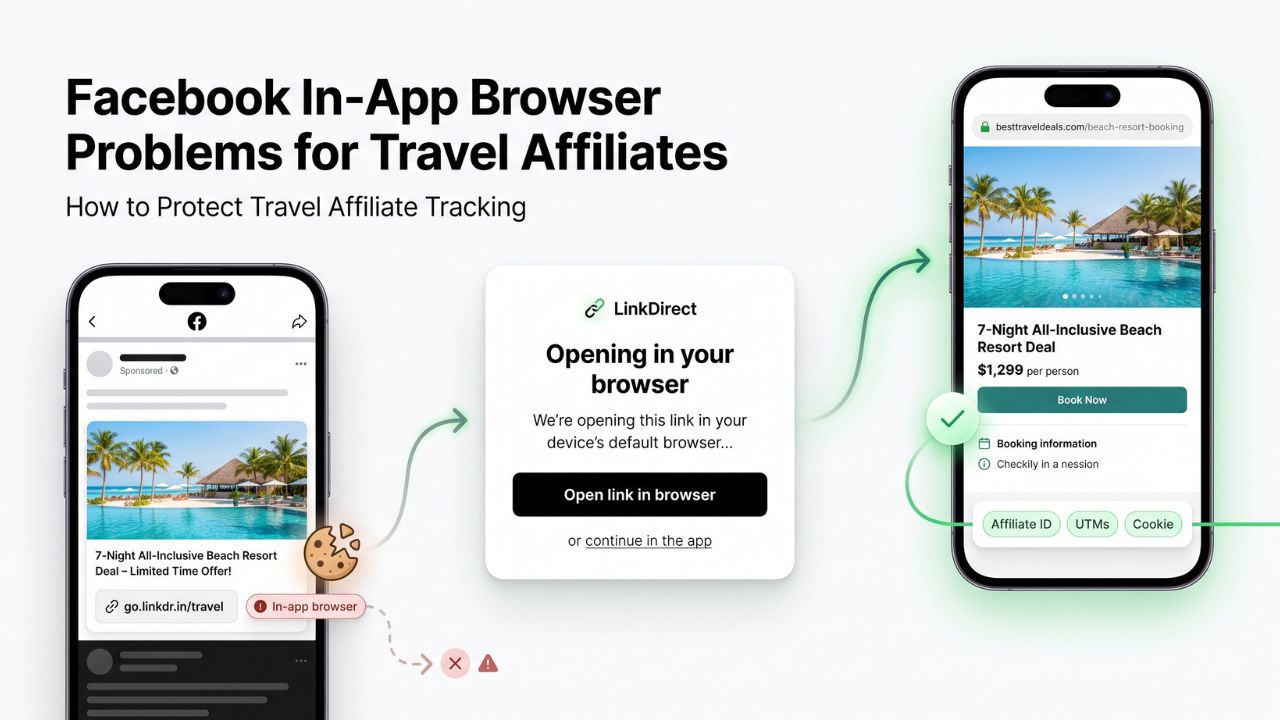
How In-App Browsers Affect the Travel Booking Journey

The cookie problem is the most important issue for affiliates, but it is not the only one. Facebook’s in-app browser can also affect the user experience during the travel booking process.

Login and Account Sessions

A customer may already be logged in to a travel platform, airline, OTA, or tour operator account in Safari or Chrome.

Inside Facebook’s browser, that session may not be available. The user may need to log in again, confirm an email, or re-enter traveler information.

This can increase friction and reduce the chance of booking.

Saved Searches and Previous Hotel Views

Travel users often return to saved searches, recently viewed hotels, favorite resorts, or partially completed bookings.

If that browsing history exists in the native browser but not in Facebook’s embedded browser, the user may lose context.

They may need to search again, change dates again, reselect airports, or rebuild the same package.

Payment and Checkout Flow

Travel checkout can be more complex than standard ecommerce. The user may need to enter passenger details, select baggage, choose insurance, add transfers, accept travel terms, and complete payment verification.

Any issue with payment handoff, banking authentication, mobile wallet behavior, or returning from another app can reduce conversion performance.

Facebook’s in-app browser does not automatically break travel checkout, but it adds another layer to a process where every extra step matters.

Mobile App Opening

Some travel brands prefer users to continue in their mobile app. Whether a link opens a merchant’s app depends on the destination, device, operating system, and link configuration.

An external browser may offer a more familiar route into the travel app or allow the user to continue on the website when app opening is unavailable.

Why Manual “Open in Browser” Instructions Are Not Enough

A travel affiliate could tell users:

“Open this link in Safari before booking.”

But this is not scalable.

Most users do not understand why browser choice matters. They are focused on the holiday, the price, the hotel, and the dates — not affiliate cookies or browser environments.

Manual instructions create friction. They interrupt the buying journey and may reduce click-through rates.

For travel affiliates posting many offers per day, the solution needs to work at the link level or website level, not through user education.

A strong travel deal should move the user from Facebook to the booking page as smoothly as possible.

How LinkDirect Helps Travel Affiliates Protect Attribution

LinkDirect is a paid subscription SaaS for affiliates, performance marketers, agencies, travel deal publishers, media buyers, and creators who monetize social traffic.

For travel affiliates, LinkDirect helps route supported Facebook, Instagram, and Messenger traffic toward the user’s external browser earlier in the booking journey. The platform uses browser-aware smart routing, environment detection, a native-open flow, attribution-safe redirects, and a conversion-friendly fallback. LinkDirect does not guarantee that every click will always open outside Facebook. The final behavior depends on the social platform, device, operating system, app version, user settings, and destination configuration.

Instead, LinkDirect attempts to guide supported users toward the best available browser path while preserving the original travel offer URL and tracking parameters.

Want to test this on your own traffic?

Start with one smart link and see how many visits reach the real device browser.

LinkDirect helps you route social traffic more cleanly, preserve tracking parameters, and measure who opens in the browser versus who stays inside the app.

A travel affiliate can create a LinkDirect smart link for a holiday deal, hotel page, package holiday, flight + hotel offer, city break, cruise deal, or all inclusive promotion.

The smart link can be placed in:

  • Facebook Page posts,

  • Facebook travel groups,

  • comments under deal posts,

  • Messenger messages,

  • paid Facebook ads,

  • Instagram Stories,

  • Instagram bio links,

  • creator campaigns,

  • travel newsletters and private communities.

When a user clicks the smart link inside Facebook, LinkDirect detects the environment and attempts to route supported users toward the external browser.

The original destination and campaign parameters are preserved, including affiliate IDs, sub IDs, UTM values, click identifiers, and other tracking values required by the travel affiliate program.

The main benefit for travel affiliates is improved cookie continuity.

If the first travel offer visit happens in Safari or Chrome instead of only inside Facebook’s embedded browser, the affiliate cookie may be more likely to remain available when the customer returns later through the same native browser. This is especially important for travel because the first click and final booking are often separated by time. A user might click an Egypt all inclusive offer at noon, compare hotels after work, and book at night. Or they might save a Turkey holiday deal on Monday and complete the booking on Wednesday.

If the cookie stays in the same browser environment the customer uses later, the chance of correct attribution may improve.

This does not guarantee commission approval. Travel affiliate networks and booking platforms still apply their own rules, attribution windows, validation processes, cancellation rules, and tracking systems. But LinkDirect helps reduce one common reason why a commission may not be connected to the original social click.

LinkDirect Site Scripts for Travel Websites

Some travel affiliates operate their own websites, landing pages, deal portals, or comparison pages.

For these cases, LinkDirect also offers site scripts.

A lightweight script can be placed in the head section of the travel website. It helps detect supported visits arriving from in-app browsers and guides those users through the LinkDirect transition flow.

This can help even when the visitor did not arrive through a LinkDirect smart link.

For example, a travel affiliate website may receive traffic from:

  • Facebook posts,

  • Facebook groups,

  • Messenger links,

  • Instagram Stories,

  • influencer campaigns,

  • paid social ads,

  • organic social shares.

Instead of optimizing only one link at a time, site scripts help apply browser-aware routing more broadly across an owned travel website.

Smart links work well for individual offers. Site scripts are useful for travel publishers and brands that want in-app browser optimization across their own domain.

LinkDirect Analytics for Travel Affiliate Campaigns

Travel affiliates need to know what happens after the click.

LinkDirect provides analytics that can help subscribers understand the click flow, including:

  • total clicks,

  • browser opens,

  • users who stayed inside the application,

  • traffic sources,

  • devices,

  • operating systems,

  • countries,

  • live click flow.

This data can be compared with travel affiliate dashboards, booking reports, conversion rates, approved commissions, rejected commissions, revenue per click, and campaign profitability. The goal is not to assume that every Facebook in-app browser visit is lost. The goal is to measure how much travel traffic remains inside the embedded browser and whether routing more users toward the external browser improves affiliate performance.

For travel media buyers, this data can also help evaluate whether Facebook traffic is underreported due to attribution fragmentation.

Best Practices for Travel Affiliates Using Facebook Traffic

Create separate smart links for each travel campaign. An Egypt all inclusive post, Turkey luxury hotel post, Greece family holiday post, and Spain last minute campaign should each have separate tracking.

Use placement-specific parameters. Separate links for Facebook groups, Page posts, comments, Messenger messages, ads, and Instagram Stories help identify which placements generate real bookings. Preserve all travel affiliate tracking values. Do not remove affiliate IDs, click IDs, sub IDs, destination parameters, hotel identifiers, campaign tags, or UTM values. Test the booking journey on iOS and Android. Check whether the offer opens correctly, whether tracking parameters remain present, whether cookies are created, and whether the booking flow works.

Pay attention to delayed bookings. Travel users often return later, so first-session conversions do not show the full value of the campaign.

Use branded subdomains. A clean branded link can build trust in travel communities where users may be cautious about unfamiliar URLs.

Compare approved commissions before and after using LinkDirect. Travel affiliates should look not only at clicks, but also at bookings, commission approval rate, revenue per click, and users who remained inside Facebook.

Why Travel Affiliates Should Not Ignore In-App Browsers

Facebook is valuable for travel affiliate marketing because it creates demand quickly. A strong hotel deal, last minute holiday, or all inclusive package can generate clicks within minutes.

But the same social environment that generates the click can also separate the first visit from the final booking.

If the affiliate cookie is stored inside Facebook’s in-app browser and the traveler later books through Safari or Chrome, the commission may be at risk in cookie-based programs. For travel affiliates, this is not a small technical detail. It can directly affect revenue from holiday deals, hotel offers, package holidays, and paid social campaigns. LinkDirect helps reduce this risk by attempting to move supported social traffic toward the user’s external browser earlier in the journey, while preserving the original offer URL and tracking parameters.

With smart links, site scripts, custom subdomains, browser-open analytics, attribution-safe redirects, and conversion-friendly fallbacks, LinkDirect gives travel affiliates more control over how Facebook traffic reaches booking pages.

Create a LinkDirect smart link and help your travel affiliate traffic open where it should.

Topics

Author

LinkDirect Editorial Team

Editorial team

5 articles

The LinkDirect editorial team writes about smart redirects, in-app browsers, attribution recovery, and mobile-first conversion flows.

FAQ

Frequently asked questions

Why is Facebook’s in-app browser a problem for travel affiliates?

Facebook’s in-app browser can store affiliate cookies in a separate browser environment from Safari or Chrome. If the traveler later returns through their normal browser to complete the booking, cookie-based attribution may not connect the sale with the original affiliate click.

Can travel affiliates lose commissions because of Facebook’s browser?

Yes, it can happen in cookie-based affiliate programs when the original cookie is stored inside Facebook’s embedded browser and the final booking happens later in another browser. The outcome depends on the travel affiliate network, merchant setup, tracking model, and attribution rules.

Does every Facebook travel click lose attribution?

No. Some travel platforms use server-side tracking, account-based attribution, postbacks, or other methods that can support attribution beyond cookies. The in-app browser creates a potential risk, not a guaranteed commission loss.

Why are travel bookings especially vulnerable to cookie separation?

Travel users often do not book immediately. They compare hotels, check flight times, read reviews, ask another person, and return later. This delayed decision process increases the chance that the final booking happens in a different browser from the first click.

How does LinkDirect help travel affiliates?

LinkDirect attempts to route supported Facebook, Instagram, and Messenger traffic toward the user’s external browser while preserving affiliate IDs, UTM parameters, and the original travel offer URL. This can improve cookie continuity and reduce attribution risk.

Can LinkDirect be used for Facebook travel groups?

Yes. Travel affiliates can use LinkDirect smart links in Facebook groups, Page posts, comments, Messenger campaigns, paid ads, and other placements where travel offers are shared.

Does LinkDirect guarantee every travel booking will be attributed?

No. Attribution depends on the travel affiliate program, tracking model, cookie duration, validation process, device, browser, and merchant configuration. LinkDirect helps reduce browser-environment separation, but it cannot guarantee commission approval.

Is LinkDirect useful for travel affiliate websites?

Yes. Travel affiliates who own websites, deal portals, or landing pages can use LinkDirect site scripts to help manage supported in-app browser traffic arriving from Facebook, Instagram, Messenger, and other social sources.

Ready to test it?

Recover more social traffic before it gets stuck inside in-app browsers.

Create smart links, add your own domain, measure browser opens, and see exactly how much traffic stays inside Instagram or Facebook before conversions disappear.